


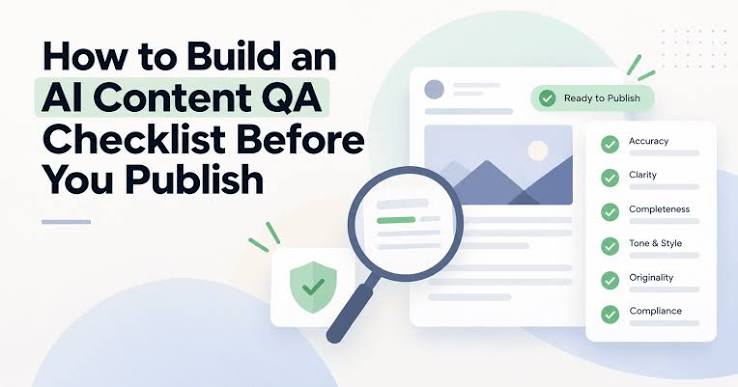
Quick Answer: use this editorial quality checklist for AI-generated copy to review grammar, tone, accuracy, and citations in one focused pass; in many…
Last updated: October 10, 2026
Key Takeaways
- Clean grammar first because mechanical errors make everything else harder to trust.
- Check tone for a specific reader on a specific day, not a generic crowd-pleaser.
- Accuracy matters most: polished wrong copy is still wrong copy.
- Use citations only when a claim needs support and the source really backs it up.
Quick Answer: use this editorial quality checklist for AI-generated copy to review grammar, tone, accuracy, and citations in one focused pass; in many drafts, 15 to 30 minutes is enough to catch the biggest problems. The editorial quality checklist for AI-generated copy: grammar, tone, accuracy, and citations works best when you read once for mechanics and once for facts, then decide what should stay, what should be softened, and what should be cut.
What this checklist is for—and what it is not
Fifteen to 30 minutes is the target here, not a full rewrite from scratch. This checklist helps when the draft already matches the topic and only needs editorial control; it is not the fix for a weak brief or a shaky strategy. For anything legal, medical, or financial, a subject expert should still review the final text before it goes live.
Table of Contents
- What this checklist is for—and what it is not
- Grammar checks that catch the obvious mistakes first
- How do I check tone so AI copy sounds like a person?
- Accuracy: the part that protects your credibility
- Citations: how to tell whether the support actually supports the claim
- The mistakes I see most often in AI-generated copy
- A simple pass/fail checklist for the final review
- What should I do before I publish AI copy?
- FAQ
Two passes usually do the job. First, I clean sentence-level problems: grammar, punctuation, repetition, and clumsy phrasing. Then I check voice, facts, and citations, and I decide what stays, what gets softened, and what gets cut. That order matters. Why polish a paragraph I may delete?
One blunt question stays in mind: “Would I sign my name to this?” If the answer is no, the draft is not ready, even when it sounds smooth. AI copy can glide along and still miss the mark. It can be polished and flat, confident and wrong. A good editorial quality checklist for AI-generated copy catches that before a reader does.
A generic article says “review everything carefully.” That is too fuzzy to help. I want a checklist that names the exact failure modes: subject-verb agreement, tone drift, invented facts, stale statistics, broken attribution, and citations that look real but do not support the claim. Otherwise, you are chasing smoke.
Grammar checks that catch the obvious mistakes first
Mechanical errors go first because they make the rest of the draft harder to trust. I start with subject-verb agreement, tense shifts, missing articles, repeated words, and punctuation that makes a sentence wobble. The goal is not elegance; it is a clean read.
Usually, I work line by line. Slow? A little. But AI text often repeats the same mistake in clusters, so fixing a pattern once can save a lot of cleanup later. Should a draft keep mixing “is” and “are,” or jump between past and present tense, I correct the pattern rather than patching every line one by one. I also watch for comma splices, fake punchy fragments, and long sentences that try to do three jobs at once.
Here is the basic procedure I use:
- Read the draft out loud at normal speed for 5 to 10 minutes. The goal is to hear where the sentence breaks feel wrong, not to admire the prose.
- Mark every line with a grammar error or a sentence that forces a reread. A standard 1,000-word draft often produces 10 to 20 marks on the first pass.
- Fix repeated mechanical issues first, such as tense, pluralization, and pronoun agreement. One correction here usually improves several nearby sentences.
- Trim sentences over 25 to 30 words if they contain more than one claim. The expected result is a draft that reads faster and leaves fewer places for error to hide.
- Run a final proofread for punctuation, capitalization, and spelling. This last pass should be short—about 3 to 5 minutes—because the larger repairs are already done.
I treat style tools as assistants, not judges, and I still consult a professional or follow house guidance when the stakes are high, as recommended in the APA Style website. A grammar checker catches obvious typos, sure; it misses a sentence that is technically correct and still clumsy. It also misses a paragraph that repeats the same noun five times. The human eye has to make the final call.
How do I check tone so AI copy sounds like a person?
I check tone by asking a simple question: does the draft sound like it was written for one reader on one day, or like a generic answer trying to please everybody? Tone is not just friendliness. It is the relationship between writer and reader, and AI draft tone often slides into vague optimism, fake confidence, or sterile corporate language.
Three phrases usually give the game away: “In today’s world,” “robust solutions,” and “seamless workflow.” They hide behind a template. So do hedges like “it may be helpful to note” when the sentence should just say the thing. When I see too much abstraction, I replace it with a concrete noun and a direct verb. “Improve content quality” becomes “catch errors before publication.” “Optimize the workflow” becomes “cut the review into two passes.”
Tone has to fit the audience, too. A draft for a SaaS blog can sound sharper and more efficient than a draft for a nonprofit newsletter. A B2B audience usually tolerates concise, practical language. A consumer audience usually needs less jargon and fewer internal terms. When the article talks like a policy memo when the reader wants help, the tone is off.
I use three questions here:
- Does the voice sound human, not manufactured?
- Does it match the brand without sounding canned?
- Would a reader in this niche say it out loud without cringing?
One honest trade-off: you can make AI copy sound more natural, but you cannot make it truly distinctive without rewriting some sentences from scratch. When the article needs a strong point of view, a joke, or a specialty voice, I do not rely on light editing. I rewrite. That is the better move for opinion pieces, brand essays, and any article that should feel authored rather than assembled.
Accuracy: the part that protects your credibility
Accuracy matters most. Grammar can be fixed in minutes; a factual error can stain trust for months. I treat every claim as untrusted until I know where it came from, even when the sentence sounds polished and the numbers look neat, and I still consult a professional when the topic is regulated or high risk.
Four kinds of risk get checked here: dates, definitions, product or model names, and claims that sound universal. AI text often invents certainty where the source material was careful. A sentence like “this is the best method” should often become “this is a common method” unless there is a defensible standard behind the claim. “Always” and “never” should make me pause. So should round numbers with no explanation.
My accuracy pass starts with the pieces most likely to go stale:
- dates and version numbers
- names of standards, frameworks, or methods
- feature lists for tools and platforms
- statistics, percentages, and rankings
- quotes that sound tidy but may not be exact
When a paragraph cites a standard such as ISO, APA, or WCAG, I check whether the standard is named precisely and whether the claim matches what that standard actually covers. Should the article reference a platform release, I confirm the version or date. When it mentions a study, I want the conclusion to match the study’s actual scope, not a headline summary. A draft can be grammatically perfect and still misstate the subject by a small but costly amount. That sort of miss is a paper cut with teeth.
This is also where I decide whether a statement should be removed entirely. If I cannot verify a specific figure, I soften the claim or cut it. I would rather publish “many teams struggle with this step” than invent a statistic to make the paragraph look complete. Often, subtraction is the strongest editorial choice.
Citations: how to tell whether the support actually supports the claim
Citations help only when they attach to a claim that needs support and when the linked material really says what the sentence says. A neat-looking footnote is not enough. I check citations for relevance, freshness, and specificity, because AI-generated drafts can produce references that look formal but miss the exact point.
My first rule is simple: cite the claim, not the topic. Should a paragraph say AI copy needs human review, a citation to a general article about generative AI will not do much work. I want a source that specifically discusses editorial review, quality control, model limitations, style guidance, or publication standards. A citation should reduce doubt, not decorate the page.
I also look for citation drift. That happens when the source is real but the sentence has wandered beyond what the source supports. For example, a source about grammar correction does not automatically support a claim about brand voice, and a source about citation style does not prove factual accuracy in a published article. I read the relevant section of the source, not just the title.
Two reliable places to anchor this topic are the Associated Press Stylebook for editorial conventions and the APA Style website for source and citation standards. For AI-specific guidance, the NIST AI Risk Management Framework is useful when I need language about reliability and oversight. I would not use a source just because it is famous; I use it because it speaks to the editorial claim I am making.
A citation pass should answer three questions:
- Is the source relevant to the exact sentence?
- Does the source actually support the claim?
- Would a careful reader trust this reference without extra explanation?
If the answer to any one of those is no, I rewrite or remove the claim.
The mistakes I see most often in AI-generated copy
The costliest mistake is treating fluent text as finished text. Smooth prose can hide a wrong claim, a tone shift, or a citation that points nowhere useful. I have seen drafts that read well at a glance and still failed because one paragraph invented a statistic, another used the wrong product name, and a third sounded like a chatbot trying to sound authoritative. A polished mistake is still a mistake.
Another common failure is over-editing for grammar while under-editing for meaning. That costs trust because the article becomes mechanically clean but strategically weak. The fix is layered editing: first correctness, then clarity, then voice, then proof. Reverse that order, and you end up preserving sentences that should have been cut.
Tone drift across sections is next on my list. An intro may sound useful and direct, then the middle slides into jargon, and the ending turns promotional. That inconsistency makes the page feel assembled from parts. I solve it by reading section headers aloud and asking whether each one promises something the next section actually delivers. When that is not true, I rewrite the transition or the heading.
Citation overkill is the fourth trap. Too many citations can make a short article feel nervous and underconfident, especially when three references all say the same thing. Too few citations do the opposite: the draft feels unsupported. I usually prefer a small number of strong citations to a scatter of weak ones. For a 1,500-word article, 2 to 4 well-chosen references is often enough unless the topic is heavy on technical claims.
Who this checklist is not for? Drafts that require subject-matter adjudication on every sentence. When the content includes regulated medical advice, legal interpretation, or financial recommendations, editorial cleanup is only step one. A specialist needs the final say.
A simple pass/fail checklist for the final review
The final review is the last 5 minutes before publication, and it should be brutal. I want a yes-or-no answer for each item, not a feeling that the draft is “basically fine.” That discipline matters because last-minute errors are usually small and embarrassing: a missing citation, a repeated word, a mismatch between headline and body, or a claim edited in one place and forgotten in another.
Here is the compact version I use:
- Grammar: no sentence-level errors that distract a careful reader.
- Tone: the voice sounds human, specific, and appropriate to the audience.
- Accuracy: every factual claim is verified or softened.
- Citations: every cited source is relevant and actually supports the claim.
- Consistency: terminology, names, and spelling stay the same throughout.
- Structure: headings match the content beneath them.
- Final risk check: no unsupported absolutes, no invented numbers, no vague “research shows” language without a real reference.
I also do one screen-length scan for visual clutter. Long blocks of text, repeated sentence openings, and citation strings piled into one paragraph all make the article feel harder than it needs to be. When the page looks dense, I break up the text. A reader should not need a ruler to find the next point.
My rule for pass/fail is strict: if I would hesitate to defend a line to a skeptical editor, the line is not ready. That standard saves time later because it prevents publication of text that will need apology, correction, or stealth editing after the fact.
What should I do before I publish AI copy?
Read it one last time for grammar, tone, accuracy, and citation fit, then remove anything you cannot defend in plain language. That final read is where weak drafts become publishable or get cut down to size. It takes less time than repairing a mistake after it has reached readers.
Keep the standard small and repeatable. Do not ask whether the article is brilliant; ask whether it is clean, true, and properly supported. A 900-word article that is accurate and well edited is better than a 1,500-word article padded with confidence and loose claims. Length does not rescue weak editorial judgment.
A good final check is to compare the strongest claim in the article with the strongest evidence behind it. When the claim outruns the evidence, weaken the claim. When the evidence is weak, remove the claim. That habit protects the article and the byline.
FAQ
How many editing passes should AI-generated copy get?
Usually two to three passes are enough: one for grammar, one for tone and structure, and one for facts and citations. A first draft that is already close may need only a quick final pass, while a messy draft may need a full rewrite.
Should I use an AI detector before publishing?
No, not as a quality check.
Drafted with AI; not yet reviewed by a person.